

VERY IMPORTANT: SAFE OPERATING PROCEDURE (SOP) FOR VEHICULAR SLIDING GATES
Congratulations on the purchase of your new vehicular sliding gate. With the correct usage procedures, regular maintenance and ongoing servicing, your gate will last for years. The estimated lifespan of a gate in a commercial or
Government environment is approximately 5 years, however our gates can easily exceed this, with some client’s having gates still working 15 and 20 years later.
WHS OBLIGATIONS:
WARNING: While our gates are built with safety in mind, all gates are potentially dangerous items that should be automated for safety wherever possible to reduce manual handling risk. In the event they are not automated, or when used in a manual override mode on an automated gate, extreme caution should be used to operate the gates. The gates we supply are not
domestic specification, they are heavy-duty, commercial or Government grade security gates, and as such are often very heavy and very large. It is the responsibility of the Owner to complete a risk assessment of operating the gate manually prior to use.
As a moving obstacle, once a gate begins moving, they will likely pick up speed and become difficult to stop. Even the slightest of slopes will cause a gate to start rolling. The larger the gate, the heavier, harder, and longer it takes to stop. If a gate cannot be automated, or needs to be put into manual operation mode (due to power outage or otherwise), the following steps must be adhered to:
VERY IMPORTANT: SAFE OPERATING PROCEDURE (SOP) FOR VEHICULAR SLIDING GATES
Congratulations on the purchase of your new vehicular sliding gate. With the correct usage procedures, regular
maintenance and ongoing servicing, your gate will last for years. The estimated lifespan of a gate in a commercial or
Government environment is approximately 5 years, however our gates can easily exceed this, with some client’s having
gates still working 15 and 20 years later.
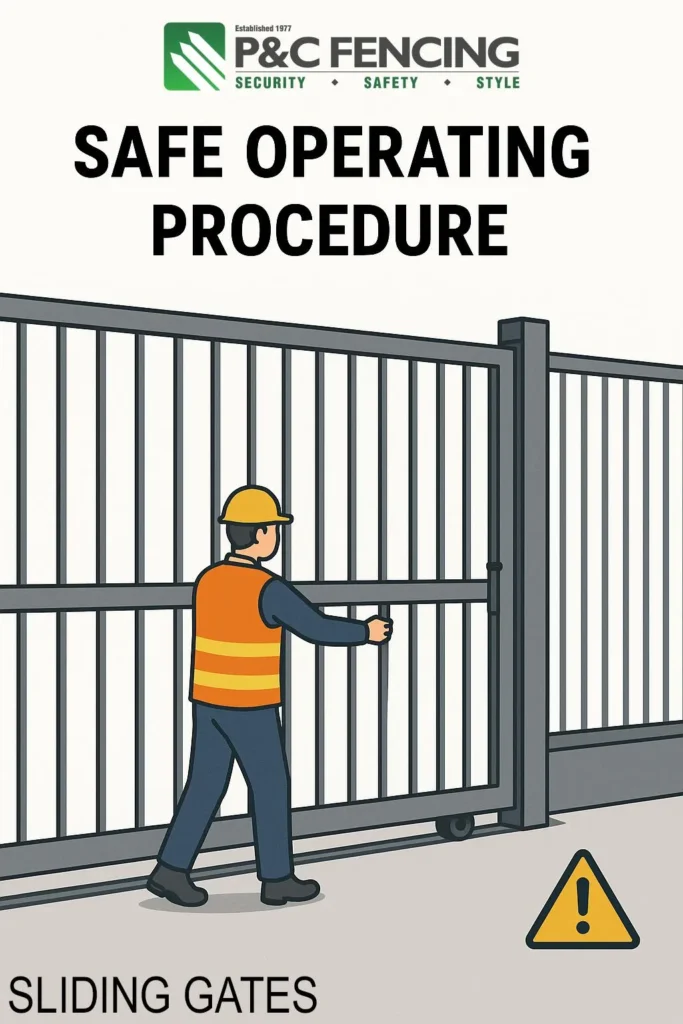
1. Ensure you are visible to all potential oncoming traffic, preferably wear high visibility clothing.
2. Ensure there are no obstacles or items blocking the path the gate will travel from the open to close position or vice
versa.
3. “Walk” the gate from one position to the next by standing next to the gate (not in front or behind it), gripping the vertical members and pushing in the direction of travel at a walking pace.
4. Never allow the gate to gain speed or momentum which is faster than a slow walking pace. Allowing a gate to slam/forcefully impact at any point in its travel will likely cause the gate safety mechanisms to fail.
5. Ensure no fingers or other extremities are on the edge of the gate, as they will likely be caught in between the gate and the stop post.
6. Ensure no part of the body is protruding through the gate, as it may be caught on unforeseen obstacles and crushed.
7. Secure any manual (non-automated) gate in either the open or closed position by way of drop-bolt and/or physical restraint, such as a suitable chain and lock. This includes gates that are automated but have the motor disconnected, turned off, or otherwise non-functional. This step is critical in preventing the swing gate catching in the wind and closing shut or slamming open unintentionally. Most gates require surprisingly little wing to begin moving and depending on the speed can cause serious injury to people or damage to buildings, vehicles, or other
objects.
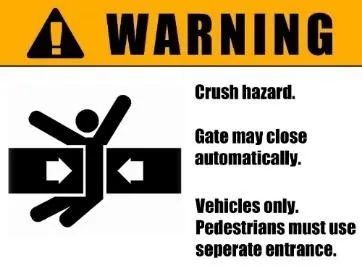
8. Never allow pedestrians to use a vehicle gate opening as thoroughfare due to the risk of oncoming traffic, as well as the safety systems are designed for vehicles, not pedestrians. Pedestrians should always use designated, labelled
walkways.
9. It is recommended for the Client to install appropriate signage as an additional safety measure.
P&C Fencing PTY LTD will not be held liable for any claims for injury, damage, death or other misfortunes due to incorrect operation of a gate.
If your operator has key lock cover or access door and you have lost track of the key, contact us for a replacement
Please note, disconnection for a substantial time, or removal of any gate operators will affect the calibrated limits and will
require a re-calibration by an authorized automation technician. Fees for re-calibration to be confirmed pending site location and scope of works.
YOUR RESPONSIBILITIES:
You must operate, maintain, and care for your gate in accordance with the instructions in your Owner’s Manual, Maintenance Manuals, and the below guidelines. Gates are made to have consumable parts that will wear with time, these include the track wheels under the gate, the
nylon rollers at the top that guide the gate. The gate stops that prevent the gate over travelling are not considered a consumable, however due to misuse or vehicular impact, these often get damaged over time and it is highly recommended to check them at least quarterly, and replace urgently as required.
In addition, they are made up of many moving parts that require regular cleaning and lubrication to ensure they operate correctly, and safely, and prevent premature wear and/or failure. As such they must be serviced and maintained in line
with manufacturer specifications. The Gate and Gate motor must be serviced every 6 months minimum (if not more frequently) please reference the below operation frequency table to determine the required frequency of maintenance and
service. It is the responsibility of the gate owner to organise servicing and maintenance of the gate. The best way to maintain your gate is through a qualified and authorised P&C Fencing Gate Technician. You, your colleagues, and visitors will be kept safe by using an authorised and trained Gate Technician that uses quality, approved parts to service and maintain your gate.
OPERATION FREQUENCY TABLE:
Gate Guide Rollers:
Regular lubrication of the guide roller bolt, tightening of the nut, and cleaning of the roller with an air pressure-can will remove potential grit build up from the roller system. Over time, guide rollers can move, so it is important to regular check their alignment, and realign them when required.
Gate Wheels and Track:
To prevent any possible jamming or ceasing of the gate support wheels, it is important to ensure both the gate wheels and track are free of any debris such as dirt, rocks, sand, bark, twigs, branches and any other obstacle that could hinder
movement.
Surrounding Areas:
If a sliding gate is installed next to a garden area, it is important the garden is retained sufficiently to prevent water, rain, wind and other natural occurrences from moving debris from the garden onto the track. Any trees, shrubs and bushes adjacent to a sliding gate should be regularly trimmed to restrict jamming of the rack, chain, cog or other moving parts of the gate and gate motor.
Safety stops:
The most important part of all servicing and maintenance is the regular inspection and replacement of any damaged or defective gate stops. These prevent the gates over-travelling and potentially coming out of their guide and catch posts. It is incredibly important the gates are used correctly, and not maliciously or negligently, which could cause the gate stops to become damaged, or dislodged altogether. Training of all users of the gates is critical in communicating safe operating procedures, and in turn, keeping the gate safe to use.
Automated Gates:
Photo-Electric (PE) Infrared Safety Beams are the safety device that prevents an automated gate closing on a vehicle or person. They often have dust and debris, including spider webs, build up on the lens, causing the beam to be blocked, causing a false reading that there is an obstruction in the driveway. This will prevent the gate from closing.
Pest spray on the motor control board is required regularly to prevent insects from housing in the waterproof electronic control board housing. This housing often gets warm, it is dark and also waterproof, which provides an ideal home for unwanted pests and insects. Pest spray applied to the housing plastic will prevent this from occurring. Please take care not to spray the electronics.
Conduits providing power or data to the gate motor is often damaged by whipper snippers, or they can simply crack over
time from prolonged UV exposure. This exposes the internal wiring to potential water damage, so the conduits should be inspected when possible, and repaired if required.
Gate motor limits are controlled by cams, which often move incrementally over time. Even though this movement is
extremely slight, over hundreds of operations it starts adding tens of millimeters to the designated limit, often leading gates to slam stop posts, or swing past their designated stop points.
Gate timers can only ever be programmed for one year in advance. Each year the designated day that public holidays fall on changes, and thus any gate timers require re-programming annually.
List of regular consumable gate and gate motor items:
The following is a list of the most common consumable gate and gate motor items that can be expected to be replaced
during the life of a gate. Depending on the frequency of use, they may only need replacing once, or several times. These are not considered warrantable items, as they are designed to wear and be replaced, much like brakes on a car. The list
includes:
• Nylon guide rollers
• Ball bearing guide rollers
• Gate wheels
• Motor rack/chain/belts
What to do if a gate becomes unsafe?
If a gate becomes unsafe for any reason, including but not limited to lack of service, vehicular impact, non-trained users,
etc. the gate should immediately be taped off and clearly labelled “unsafe for use – out of order” or similar, and ideally
chained open or closed to prevent further use. In addition, any possible regular users should be notified of the gate being
out of order and unsafe for use. NEVER attempt to repair a gate without proper training and risk assessment. Only trained
and skilled workers should ever attempt to repair a gate or gate motor once deemed unsafe.
If in doubt, call our team on 9605 1111 for advice.
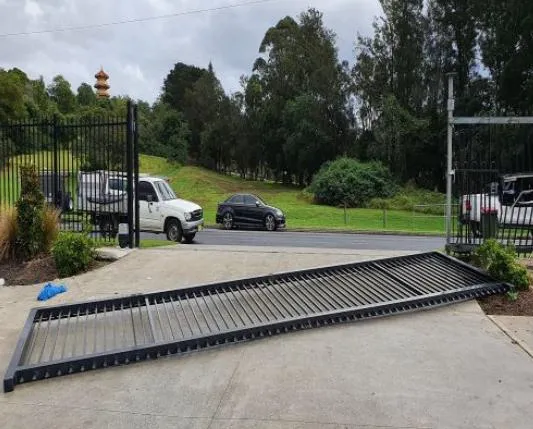
The most common and dangerous issue with a lack of safe operating procedures being observed, or a lack of service and maintenance for gates, is a mechanical failure.
This can be caused from various problems, including but not limited to untrained use, misuse, rusted components, worn consumables, vehicular impact, or malicious damage.
The outcome is often serious damage to persons or property, or even death.

A sliding gate wheel collapsed from lack of lubrication.
This gate will no longer move smoothly, which will cause
damage to the gate motor, or simply prevent the motor from being able to move the gate.
Manual operation will also be difficult or impossible.
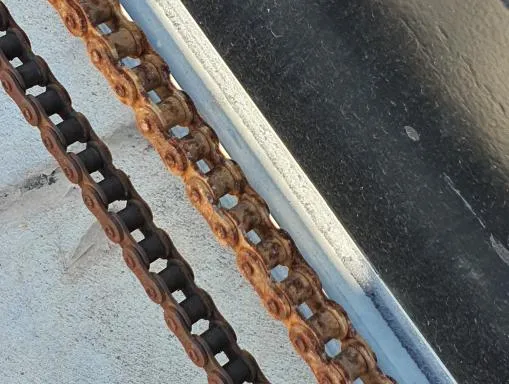
Rusted gate motor chain from a lack of lubrication.
This gate will no longer move smoothly, which will cause
damage to the gate motor, or simply prevent the motor from being able to move the gate.
Manual operation will also be difficult or impossible.
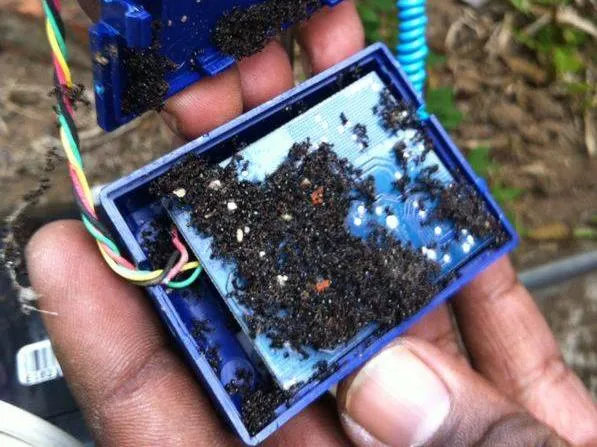
Insect infestation in electronic controls. Insects often seek the warmth or dryness of the electronic components within a gate motor.
Regular pest spray will prevent this occurrence.
Pests often bridge and short circuit electronics within a gate motor, causing hundreds if not thousands of dollars of damage.
KEEP IT SERVICED, KEEP IT MAINTAINED, KEEP IT SAFE!